
The versatility of acrylic paint means it can be used on a wide range of surfaces. All you need to know is which medium is best suited to your needs and budget.
I’m often asked which medium I use the most, which is the most suitable and offers the best value for money for beginners.
I’ll try to answer these questions as precisely as possible!
I’m a beginner and I don’t know what to paint!
Don’t worry, it’s perfectly normal. I asked myself a lot of questions when I started acrylic painting.
I wanted to learn, to be able to try out as many things and techniques as possible on a very small budget and with little storage capacity.
It was therefore obvious that the use of canvas frames would have been totally premature in my case.
So I explored different avenues and tried out different materials: paper, cardboard, cardboard, PVC…
Substrates suitable for acrylic paint
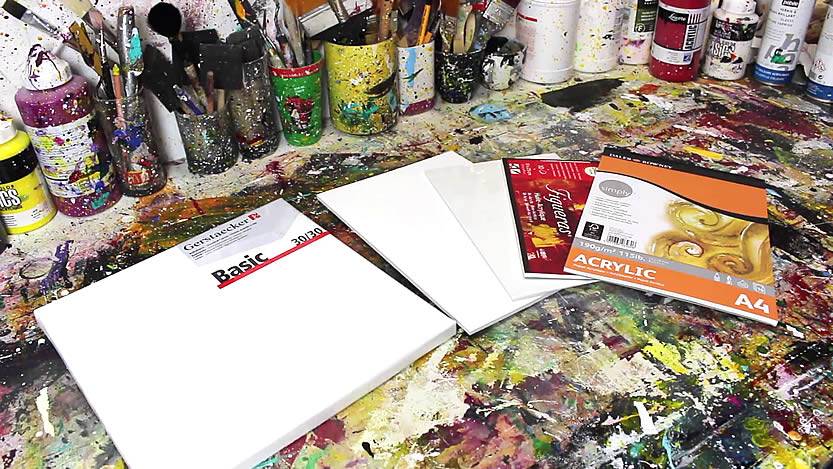
Acrylic paint on paper
Basically, paper isn’t suitable for acrylic paint, as it’s usually too thin, absorbing water and causing the paper to curl.
However, heavier-weight papers are also available. I’d say a minimum 190g/m2 paper will do the trick.
You’ll find many brands offering blocks of sheets dedicated to the use of acrylic or oil paints.
For reasons of cost and storage, this type of product is perfect for acrylic painting practice for beginners.
Buy a block of acrylic paper sheets 450g/m2
The box
You can also use cardboard to create abstract paintings using acrylic paint.
Any type of cardboard will do, but I recommend several coats of Gesso.
If you want to know more about Gesso and how to use it, I recommend the following articles:
The canvas cardboard
Interlining is simply a fabric wrapped around a sheet of cardboard. The stand is slim and sturdy.
This support provides a natural transition to the canvas frame.
In my case: After a few inconclusive attempts on different types of paper, I began my acrylic and abstract painting practice with canvas board.
The canvas frame
The canvas stretcher is the most widely used support for acrylic painting. It can be considered a standard.
The principle is simple: a canvas is stretched over a wooden frame. Frame keys can be used to stretch the canvas to suit your needs.
Canvas supports age well over time and provide a quality base for your paintwork. (Please note: this is subject to the purchase of good quality canvas frames).
In my case: The canvas frame is the medium I use most. I use it either on its own, or in several copies as part of polyptych creations. It’s a medium that’s easy to work with, easy to exploit and meets almost all my needs as a modern painter.
View / Buy canvas stretchers on the fine art giant
The wood
Wood is also widely used in acrylic painting. You can use different types of wooden supports.
Wooden plates
It’s perfectly possible to use a classic wooden plate for your painting practice.
However, you need to make sure that the wood you use is thick enough and that it will age well over time and not warp with temperature changes.
To prepare your wood panel, you’ll need to apply a few coats of primer, such as Gesso.
Wooden panels
Wooden panels are supports made exclusively for the practice of fine art.
The wooden stand consists of a wooden plate and 4 other pieces to form a sort of frame for a sturdy stand.
View / Buy a wooden panel to paint
Other original media
In fact, many modern painters love to use anything they can get their hands on as a canvas.
Here’s a list of the supports I’ve had the pleasure of seeing:
- Glass painting (on bottles, for example)
- Painting on a guitar
- Painting on faience
- Painting on rubber
- Painting on plastic
- Painting on PVC or other rigid substrates
- Clock painting
- Book painting
- etc! (The list would be so long…)
In conclusion, as long as your surface is well roughened with Gesso, for example, it will stand the test of time. So you can adapt any medium you can think of to create your future work. What about you? What’s your favourite painting medium?




Leave a Reply