
You don’t know how to choose your paint and don’t understand what you see on the tube label?
Don’t panic! Let me explain.
It’s important to choose the right paint for your budget and your needs. And to do this, it’s imperative to understand the different information displayed on your acrylic paint tubes.
Mastering this information will enable you to make the right choice and use & mix your paints without the slightest fear.

Opacity / transparency / coverage
Opacity is one of the most important elements to understand.
Paint is more or less opaque. It depends on the brand, the type of paint (study, fine, extra-fine), etc.
There are generally four types of opacity: transparent, semi-transparent, semi-opaque and opaque.
On acrylic paint tubes, opacity is usually represented in the form of squares.
“My paint doesn’t cover your canvas very well”
I’m sure this is something that’s happened to you before: your paint doesn’t cover your canvas properly.
When you’re just starting out, you usually buy study acrylic paint. Study acrylic paint is often semi-transparent or semi-opaque for reasons of manufacturing cost.
This is why paint sometimes covers your canvas poorly and requires a second coat of paint.
Opacity depends on the nature of the pigment and the quality of its grinding.
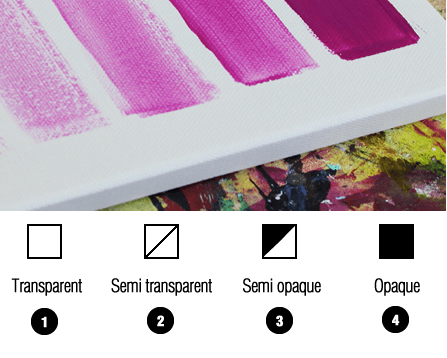
Classification of opacities :
- Empty square (Transparent): The paint is very transparent. It’s easy to see through the paint.
- Crossed-out empty square (Semi-transparent): This is the opacity level above transparency. The color has faded, but you can still see through the paint.
- Half-filled square (Semi-opaque): Semi-opaque paint is what you find most often in study paintings. The collection power is rather opaque, but you still have transparency. This can be corrected by applying another coat of paint.
- Filled square (Opaque): Opaque paint has full covering power. It is the opposite of transparency.
Please note: Just because your paint has a transparent or semi-transparent opacity doesn’t mean it’s of poor quality. Some painting techniques require the use of paints of this type to work layer by layer (for example, to make glazes).
Light fastness, UV resistance
Acrylic paint can be altered over time by ultraviolet rays and, more generally, by light.
In other words, the color of the paint used may fade over time, depending on the conditions.
Light resistance is represented by stars:
- ** (Two stars): Your paint will keep for 25 to 100 years.
- *** (Three stars): Your paint will keep for over 100 years (provided it’s in an optimal living environment: not too much sun or harsh light).
Note: Nowadays, acrylic paint has a long service life. Indeed, even on most study paintings, you’ll get three stars.
Color name
This is usually the first thing you look at on your paint tube: the color name.
I won’t go into detail here, but it’s simply the name of the paint shade, for example: “Primary Yellow”. This is the easiest way to quickly identify a paint.
Color number
In addition to the color name, some brands use a number to identify the color.
Pigment(s) used
Acrylic paint is composed of a binder and pigments. Pigment is simply the coloring substance in your paint. If you want to know more about pigments and binders I recommend you to watch my following articles & videos:
Generally speaking, each tube of acrylic paint should show the pigment(s) used. As for primary yellow, the pigment used is PY74.
If you’d like to know more, here’s a list of all the pigments.
Tone, Value & Saturation
Some brands, like liquitex in my example, go so far as to communicate tone, value and saturation.
These values will enable you to check the exact color match using, for example, the Munsell color system.





Leave a Reply