
When you’re new to abstract painting, you tend to wonder how to use acrylic paint.
Which acrylic paint should I buy? Can acrylic paint be mixed? If so, with what?
Don’t panic! I’ll answer all your questions! 🙂
Before you start, what acrylic paint do you need?
There are different types of acrylic paints:
- Acrylic study paint / fine
- Extra-fine acrylic paint
I recommend using acrylic study paint. To find out more, I’ve written an article on the subject which I invite you to discover: Which acrylic paint to use.
Why do I use acrylic paint?
As part of my abstract painting practice, I use acrylic paint exclusively. Acrylic paint is fairly inexpensive (at least for study paints) and dries quickly!
This is a major advantage when working with abstracts, as it allows you to work quickly with multiple layers.
So how do you use acrylic paint?
You can use acrylic paint in a variety of ways:
- Acrylic paint alone
- Mixing acrylic paint with a painting medium
- Mixing acrylic paint with water
Using acrylic paint alone
Acrylic paint can be used on its own, without mixing with water or any other painting medium.
This allows you to pick up the paint directly with your brush, spalter or knife and use it immediately. You can also apply paint directly to your canvas.
The advantage of using acrylic paint alone is that it has a high covering power and is fully opaque.
This method is generally used for overlays, solids and backgrounds of the same color.
Acrylic paint with a knife
Acrylic paint alone is also widely used if you practice painting with a knife.
Generally, you take the paint directly from the tube and apply it to your canvas or other surface, without mixing it with water.
Mixing acrylic paint with water
Using acrylic paint with water allows you to meet many needs.
Using water in acrylic paint will help to thin the paint. This makes it easier to use.
How much water should I use?
It’s a question that comes up a lot. And to answer your question, I’d like to tell you that there’s no “real” answer.
For example, in my case, I always use different dilution rates depending on the results I want to obtain.
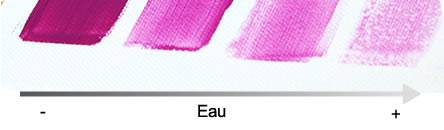
Above all, you need to understand the following principle: The more water there is, the more transparent your paint will become.
In fact, the more water you add, the lower the pigment concentration. As a result, your paint loses its opacity and gains in transparency.
Why make paint transparent?
Transparency lets you achieve striking effects. Among other things, this is the principle behind the glazing technique.
For example, you can apply a rather opaque first coat of paint. Once dry, apply a new coat of clear paint (diluted with water). Transparency allows you to see details associated with your first coat of paint.
Influence of water on drying time
The amount of water also affects drying time. The more water in your acrylic paint, the longer it will take to dry.
How to mix paint and water?
You can mix paint and water in different ways:
- Take water directly from a container, using a small brush, then mix directly into your paint until you obtain a homogeneous texture.
- By applying your paint directly to your canvas, then spraying with a water-based spray(Discover it in my guide to abstract painting equipment).
Mixing acrylic paint with a painting medium
If you don’t want to use water, you can opt for a painting medium.
Like water, painting medium helps to fluidize your acrylic paint before application.
To conclude
It is not conceivable to use acrylic paint systematically without mixing it with water or another painting medium. Unless you use your painting knife exclusively.
Concerning paint/water mixtures: The more water you use in your acrylic paint, the more transparent your paint will become.
In my case, I often use water with very different dilution rates, so as to be able to use a maximum number of techniques and achieve beautiful effects.





Leave a Reply