
Acrylic paint is very easy to use, but it’s not always easy to know which equipment to use!
So in this article and video, I’m going to show you just how many possibilities there are, by presenting my own use and equipment for acrylic paint.
First of all, it’s important to know that the material I’m about to present isn’t exhaustive. I use it as part of my abstract painting practice, and there are plenty of other solutions.
Acrylic paint
Acrylic paint is a widely used, popular and highly appreciated paint today.
Acrylic paint is quite different from oil paint, and is quite popular because it benefits from the following advantages:
- Acrylic paint dries very quickly (from a few minutes). This will enable you to go
and work layer by layer. - It can be diluted with water and resists water as soon as it dries, giving very different renderings.
- It is often less expensive than oil paint
To find out more about acrylic paint, I recommend the following articles and videos:
- How to mix acrylic paint
- How to use acrylic paint
- How to choose your acrylic paint
The materials I use for acrylic painting
Before getting started, I suggest you download the material guide for abstract painting with acrylic paint (click to find out more).
Acrylic paint with brushes
The brush is statistically and historically the most widely used medium for acrylic painting. But there are plenty of other alternatives.
There are many different types of brushes, including :
The round brush
This brush is quite versatile, allowing you to work on contours, fill in tight spaces and do precision work.
The flat brush
This brush has a square tip and straight bristles. This brush is effective for covering large areas, creating both blends and straight lines.
The oval brush
I use this brush to create and extend my points of light (see “Creating an abstract painting”).
The fan brush
This wide-bristled brush is ideal for special effects and textures.
The beveled brush
This brush is suitable for precise strokes, lines and curves.
The tracer brush
Long, pointed tip for lettering, lines and fine details
In my case, I use brushes mainly for precision work and for blending.
As mentioned in the video, this is the famous brush I use for effects and blending:
Daler Rowney Goat Hair Brush (Click to buy)
Acrylic paint with Spalter
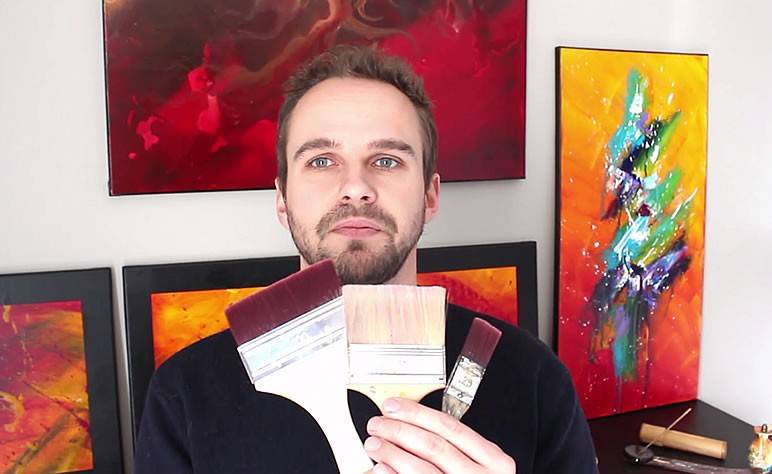
The spalter is a kind of larger brush, and I use it a lot.
I find that the spalter has a big advantage: it allows you to cover/paint a large surface quickly and efficiently, which, among other things, solves the problem of acrylic paint’s rapid drying time.
In my case, I work on large surfaces, often polyptychs. So I need to apply the paint quickly and efficiently. So the spalter meets my needs perfectly.
The spalter I use most often is the size 100 synthetic fiber spalter.
You can easily find spalters at fine art suppliers, but you can also buy your spalters from building paint suppliers.
Acrylic paint with a knife
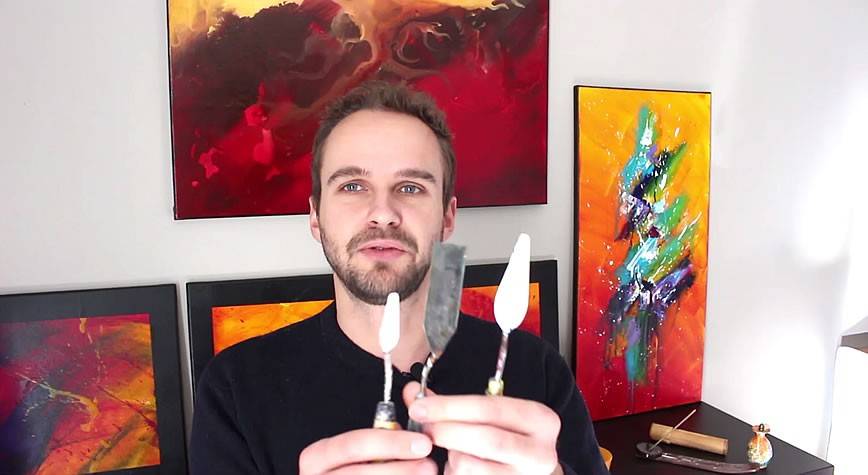
The knife is a very different approach to applying paint with brushes or spalters.
The knife is a metal object used to apply paint directly to the canvas. The knife requires more acrylic paint, but the experience is really interesting.
You can use your knife alone or use mixed techniques (knife, roller, paint, etc.).
There are many different knife sizes to choose from, depending on your affinities and needs.
Acrylic paint with a knife: Ideal for letting go!
Many of you have told me about your inability to let go and be creative.
If this sounds like you, I highly recommend acrylic painting with a knife. Indeed, I find it easier to move forward and “let go” using the painting knife. All you need is a few colors, a knife, a canvas and let yourself go!
In my case, I often use knives: either alone or in mixed techniques. But in any case, I find that acrylic paint is perfectly suited to knife painting.
Poscas
Posca is a painting pen. This one is filled with acrylic paint. You can use it to make your own acrylic paints.
Personally, I mainly use Posca to sign my paintings.

Rollers
The foam roller is a good ally for abstract acrylic painting. In my case, I use it to paint all the edges of my paintings.
Foam brush
Foam brushes are more rarely used. Made from the same material as the roller, the foam brush is ideal for painting with acrylic paint, and is often used for painting edges or applying liquid varnish/solvent.
Don’t settle for just fine art supplies!
Indeed! Having started out as a self-taught acrylic painter, I was able to discover and experiment with a whole range of materials that didn’t come from fine art supplies.
You can use anything you can get your hands on: tiling equipment, painter’s tools, kitchen utensils, and so on.
Original knives
I use a whole range of knives to create beautiful effects and apply acrylic paint in unique ways.
I recommend, for example, using large painters’ knives or glue knives used by tilers.

What about you?
Thank you for sharing your story and telling us what equipment you use for your acrylic painting practice.




Leave a Reply