
When you’re just starting out in drawing or painting, there comes a time when everyone is faced with this existential question:
“I’ll take some A4… or grapes… or half-grapes… and why is there a size called ‘Jesus’?!”
Between A-series sizes, fine art papers, weights, textures, and dimensions that can sometimes be a mystery, choosing paper can quickly feel more like taking a math test than preparing a work of art.
And yet, understanding paper sizes is extremely useful. It allows you to:
- to compose his works more effectively,
- to choose the right medium for the technique,
- to avoid wasting paper,
- and most importantly… to stop buying “on a whim.” 😅
In this article, we’ll take a look at the following:
- standard paper sizes,
- traditional fine art formats,
- the differences between A4, raisin, grand aigle, etc.,
- How to choose the right format for your practice,
- and what sizes to use for drawing, watercolor, or acrylic painting.
Understanding Standard Paper Sizes
Most of the sizes we use today follow the ISO 216 standard, which is based on the well-known A series: A0, A1, A2, A3, A4…
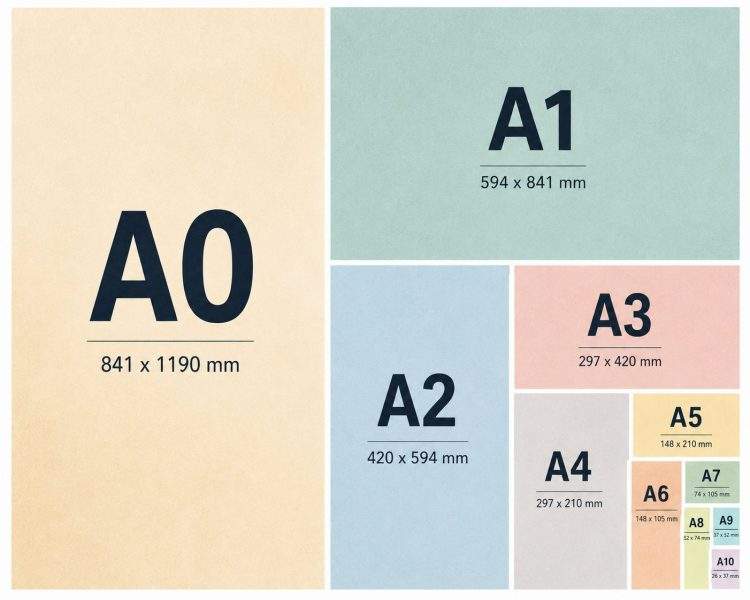
The principle is simple:
- Each format is obtained by dividing the previous one in half,
- while maintaining the same proportions.
The standard size is A0, which covers exactly 1 m² of area.
The Most Well-Known Formats
| Format | Dimensions |
|---|---|
| A0 | 84.1 × 118.9 cm |
| A1 | 59.4 × 84.1 cm |
| A2 | 42 × 59.4 cm |
| A3 | 29.7 × 42 cm |
| A4 | 21 × 29.7 cm |
| A5 | 14.8 × 21 cm |
The A4 is obviously the best known, since it corresponds to the standard printer sheet.
But in the art world, larger formats are often preferred in order to allow for greater freedom of movement and more ease in composition.
Why are A-series formats so convenient?
A-series formats have a huge advantage:
👉 They always keep the same proportions.
This means that we can:
- easily enlarge a work of art,
- to scale down a drawing without distorting it,
- scan or print without losing the framing,
- Cut a sheet in half while maintaining the same aspect ratio.
That is also why they are widely used:
- in printing,
- in publishing,
- in art schools,
- and for reproductions.
Traditional fine art formats
And now we’re entering the wonderful world of strange names. 😄
Because in the fine arts, we also use traditional French formats such as:
- grapes,
- the half-grape,
- Jesus,
- the golden eagle,
- high society,
- or even the shell.
These formats are very common in art schools and studios.
The Main Fine Art Formats
| Format Name | Dimensions |
|---|---|
| Grape | 50 × 65 cm |
| Half-grape | 32.5 × 50 cm |
| Jesus | 56 × 76 cm |
| Golden Eagle | 75 × 105 cm |
| A large crowd | 80 × 120 cm |
The most famous is clearly the “grape” shape, considered a classic in art studios.
Why is the “raisin” format so popular?
Grapes are an excellent compromise:
✅ Large enough to work comfortably
✅ Not too bulky
✅ Easy to carry
✅ Perfect for learning composition
In fact, it’s a very widely used format:
- in art classes,
- art schools,
- life drawing workshops,
- and academic exercises.
Many artists even consider the grape to be THE ideal medium for improving their skills.
What is the difference between fine art sizes and A sizes?
A formats are industry-standardized.
Fine art paper sizes, on the other hand, stem from a historical French tradition linked to the artisanal production of paper.
In practice:
| A Formats | Fine Art Formats |
|---|---|
| ISO-Standardized | Artistic Tradition |
| Widely used in printing | Widely used in art |
| Constant ratio | Various Ratios |
| Easy to replicate | More “artistic” |
| Very practical | More expressive |
Paper weight: an essential factor
Choosing a format is important.
But choosing the RIGHT weight is just as important.
The basis weight is the weight of the paper expressed in g/m².
The higher the basis weight:
- the thicker the paper,
- the more water-resistant it is,
- …the more it tolerates wet conditions.
What weight should you choose based on your technique?
For pencil drawing
👉 90 to 160 g/m²
Perfect for:
- sketch,
- sketches,
- quick studies.
For charcoal and pastel
👉 160 to 224 g/m²
Thicker paper prevents it from wrinkling when erased.
For ink and gouache
👉 200 to 250 g/m²
The paper is starting to hold up well against moisture.
For watercolor
👉 at least 300 g/m²
This is THE recommended standard for preventing warping.
For acrylic paint
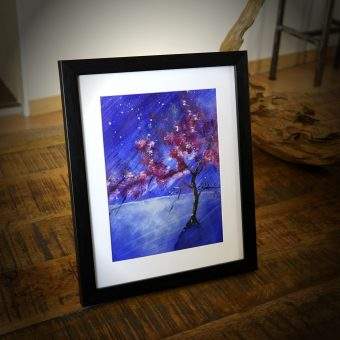
👉 300 g/m² and above
Papers specifically designed for acrylics often have a texture similar to canvas.
Paper texture: a detail that makes all the difference
The grain refers to the texture of the paper’s surface.
And this detail has a huge impact on the final result.
The Different Types of Grain
| Grain Type | Usage |
|---|---|
| Smooth | Pen, marker, details |
| End | Pencil, light watercolor |
| Medium | Versatile |
| Strong | Charcoal, pastel |
| Dish Towel | Watercolor |
| Canvas | Acrylic, oil |
Very smooth paper will produce a precise result.
Textured paper will add more character and depth.
Which format should you choose when you’re just starting out?
Here’s a simple truth:
👉 Many beginners choose formats that are too small.
Result:
- stiff movements,
- tight formations,
- difficulty relaxing the wrist,
- rigid works.
If you’re just starting out with abstract painting or expressive drawing, try this instead:
- from the A3,
- from A2,
- or grapes.
Your arm will feel better right away. 😄
Small format or large format: which one should you choose?
The Benefits of a Compact Size
✅ cheaper
✅ quick to make
✅ less intimidating
✅ perfect for school
The Benefits of Large Format
✅ More freedom
✅ A wider range of motion
✅ More dynamic compositions
✅ Visual immersion
The best advice:
👉 Alternate between the two.
The Most Common Sizes in Acrylic Painting
In acrylic painting, we often find:
| Usage | Recommended format |
|---|---|
| Quick Studies | A4 / A3 |
| Writing Exercises | Grape |
| Abstract Series | A2 / grape |
| Movement-Based Work | Golden Eagle |
| Large painting | 80 × 120 cm and larger |
The larger the format, the more important body language becomes.
And in the abstract… it changes everything.
RA and SRA formats: What are they used for?
The RA and SRA sizes are slightly larger versions of the A sizes.
They are mainly used:
- in printing,
- to estimate margins,
- non-repayable funds,
- and the cutouts.
Example
| Format | Size |
|---|---|
| A3 | 297 × 420 mm |
| RA3 | 305 × 430 mm |
| SRA3 | 320 × 450 mm |
The principle:
- RA = Raw Format (+5%)
- SRA = Supplementary Raw Format (+15%)
How Can You Choose the Right Format Wisely?
Before buying paper, ask yourself these questions:
1. What technique do you use?
Watercolor? Acrylic? Charcoal? Ink?
2. Do you use your wrist… or your arm?
The “bigger” you work, the larger the format needs to be.
3. Would you like to have your artwork framed?
Standard sizes make framing much easier.
4. Do you work from home or in a studio?
A large piece of furniture in a small apartment can be… a bit of a challenge. 😅
The Most Common Mistakes
Choosing paper that is too thin
Result:
- curl in the paper,
- damaged surface,
- immediate frustration.
Use a small format to learn composition
This often leads to “drawing in small details” instead of building the image as a whole.
Ignore the grain
Grain has a huge impact:
- the texture,
- the tagline,
- the feel of paint.
The best advice for making rapid progress
Try out several formats.
Really.
Many artists think they have a technical problem…
… when in fact they’re just working in a format that doesn’t suit them.
Sometimes:
- switch from A4 to grapes,
- or from a small notebook to a large sheet of paper,
- completely unleashes creativity.






Leave a Reply