
Hello my artist friends!
Today, I’m going totell you about the different ways of working and arranging your canvases!
In fact, every week I have questions that come up again and again:
- “Do I have to buy an easel?”
- “Can I work on a table?”
- etc.
So I’ve decided to do an article on the different ways to work on your paintings!
 The easel
The easel is the most classic way to work on a painting. An easel is a tripod-like support that holds your painting while you create it.
First of all, you need to differentiate between a workshop easel and an exhibition easel. (To find out more about the difference, please go to
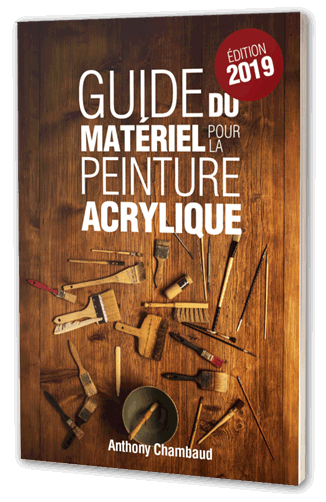
download the painting equipment guide
)
The easel is practical in the sense that you can work seated in front of your canvas.
The easel allows you to position your canvas at an angle averaging between 45° and 90°.
To use it, simply place the three feet on the ground, then present and secure your canvas on the base provided.
The advantages of the easel
- Space-saving and easy to store
- You can use it in small spaces
- Its mobility makes it easy to catch the light
- You can take it with you when you travel
- You can sit down in front of your board and work comfortably.
- You can take a step back from your painting by stepping away
The disadvantages of the easel
- It’s not made for working on large formats
- You cannot work on polyptychs (a polyptych is a painting composed of several canvases).
Working flat
 It was Jackson Pollock who at the time, out of need, clearly announced that easels were obsolete and would soon disappear.
Working flat simply means working on a table, workbench or floor.
It’s my favorite way of working and allows me to meet all my needs and wildest ideas!
The benefits
- You can easily work on polyptychs and large canvases.
- You usually work standing up, so you can be dynamic and move efficiently around the board.
- You can work with liquids and freeze more or less liquid textures.
Disadvantages
- If you’re on your feet, you may experience muscular strain and tire more quickly.
- If the workbench is too low, you run the risk of arching your back too much and suffering back pain.
- It’s difficult to stand back from your painting (My solution: Use a ladder-type stepladder to gain height and look at your painting).
Working on the wall
This is another technique used by contemporary artists working on very large formats.
The aim is to work at 90° by simply placing your canvas on the wall. You work standing in front of your canvas and can easily move around on it.
The benefits
- You can easily move from one corner of the canvas to another.
- You can easily stand back from your painting.
- You can use some nice drip effects, but this still requires a certain amount of experience, anticipation and dexterity.
Disadvantages
- It requires space
- You need to have plenty of nails and fasteners on your wall to accommodate as many formats as possible.
- You’re clearly going to cover your wall with paint!

To conclude
My favorite method is flat work, which is the most versatile way of working for me. This suits me because I’m a painter specializing in abstract painting.
But for those who practice figurative painting, the easel is more common and often the most appropriate.
What about you? How do you work on your paintings? Do you have any other working methods?




Leave a Reply