
(To see the video, click on the play button above)
When you practice abstract painting using acrylic paint, you often wonder how to make a background easily? How to create a background that will form a solid basis for the beginning of our composition and painting.
Here’s a short tutorial, one of my techniques for creating an acrylic background with ease.
Special features of acrylic paint
Before embarking on the creation of our acrylic background, it is important to understand the different characteristics of acrylic paint:
- Acrylic paint dries quickly,
- In some cases, acrylic paint can change shade after drying,
- It is possible to mix colors together(see my article on paint mixing).
- It’s a good idea to use a little water to increase fluidity(see my article on using acrylic paint).
How to make a background with acrylic paint
My specialty is abstract painting. So I’m going to show you my method for making backgrounds easily using two or more colors/shades.
The equipment used
In this example, I use the following equipment dedicated to acrylic painting:
- Gerstraeker canvas stretcher 60cm x 60cm.
- Amstertam fine/study paint tubes.
- A tube of Carmen red acrylic paint
- A tube of yellow/orange paint
- Vinci spalter size 100.
- Humidifying spray (water-based)
To discover all the materials I use, I invite you to download my free 20-page guide to acrylic & abstract painting materials.
Step 1: Applying the first color
First, I moisten the canvas with my spray, a few strokes are enough.
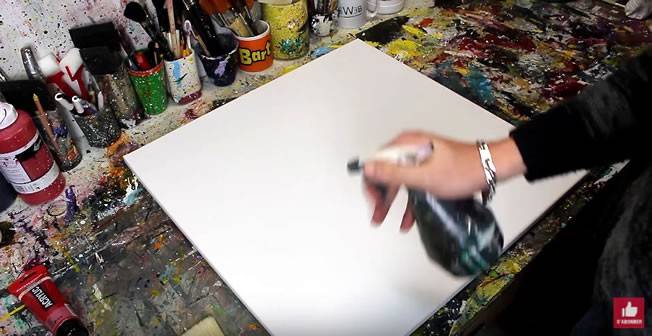
Next, I apply my first coat of paint evenly over the entire canvas. I add a little water when necessary.
I take care to fill all the spaces on the canvas so that there’s no white left (the canvas’s white).

Step 2: Application of the second color
At this point, I apply a little of my second color to the lower part of my painting.
The importance of depth
In a painting, I think it’s very important to have depth in the composition. To achieve this, I use a lighter shade in the center.
I gradually blend my two shades, working my way up towards the center. How to create a gradient with acrylic paint.

What next?
Once you’ve created your first acrylic base, you must wait for it to dry.
This first layer will clearly be a good base for the rest of your painting.
If you want to go further and learn how to make an abstract painting easily, I recommend you discover my online painting courses.





Leave a Reply