
You’ve heard about it many times, but you don’t know what it’s for. The color wheel is an indispensable tool in acrylic painting, whether you’re creating abstract or figurative works.
which allows you to combine the right colors in a painting to create a harmonious whole!
But let’s go even further! Ideally, you should create your own color wheel to understand how colors mix and react with each other. With a little practice, you’ll be able to handle colors and their mixtures with ease, and the association of hues will hold no secrets for you!
Acrylic paint tubes: the 3 primary colors
Good news! There’s no need to leave half your paycheck in the acrylic paint tube aisle at your favorite art store. Simply equip yourself with 3 essential tubes of acrylic paint the 3 primary colors!
The primary colors are :
🖌️ magenta red, also called primary red (although it’s not red at all, but rather a little pinkish),
🖌️ cyan blue, or primary blue,
🖌️ cadmium yellow: primary yellow.
By simply mixing these 3 basic colors , you’ll obtain all the colors of the color wheel, and many more besides!
Of course, flashy, silver, metallic and copper colors are excluded.
What is the color wheel?
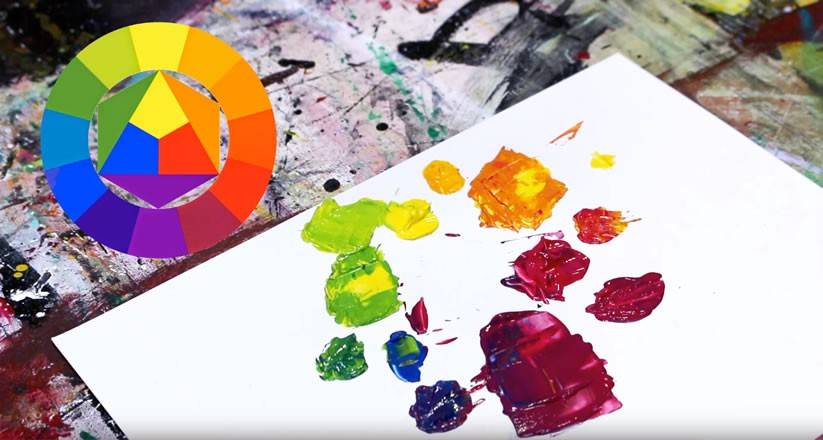
If you search the net, you’ll find all kinds of chromatic circles. There are no good or bad ones, and the one I’m proposing is simple to make. It makes it much easier to understand how colors mix and react to each other.

The color wheel is the set of colors that can be obtained in acrylic paint by representing only pure hues, in the form of a disk.
How to make a color wheel
Making your own color wheel will help you get the hang of color mixing.
To do this, you need :
- 1 compass or round object (small plate, etc.) to draw a circle,
- 1 sheet of paper + 1 pencil,
- your 3 tubes of primary colors,
- a little water,
- 1 cloth,
- 1 medium-sized brush,
- 1 pallet.
How to make a color wheel :
- draw a circle with a pencil,
- divide your circle into 6 large triangles of equal size,
- divide every 2nd large triangle into 3 new small triangles.
Paint each of the 3 large triangles with each of the primary colors.
The result is a circle with 3 large triangles in the colors of the 3 primary colors, between which you have your 3 small, empty triangles.
How to obtain the intermediate colors?
Now it’s time to fill in the small triangles, which will be painted with so-called “intermediate” colors. Among these gradients, you’ll obtain secondary and tertiary colors.

Secondary colors
These are the colors obtained by mixing 2 primary colors. On the color wheel, they are located in the small triangle at the center of the 3.
To make a secondary color, two primary colors must be mixed together.
- yellow ➕ magenta 🟰 orange,
- blue ➕ magenta 🟰 violet,
- blue ➕ yellow 🟰 green.
Tertiary colors
A more subtle step, but an important one for understanding how to use colors together in a painting.
💡Be sure to keep a little of each secondary color you’ve made on your palette each time. Tertiary colors are the result of mixing a primary color with its secondary 😉.
- primary yellow ➕ orange obtained above 🟰 orange-yellow,
- magenta (primary) ➕ orange 🟰 red,
- magenta (primary) ➕ violet 🟰 purple,
- cyan blue ➕ violet 🟰 ultramarine blue,
- cyan blue ➕ green 🟰 turquoise green,
- green ➕ primary yellow 🟰 light green.
Congratulations 🥳! You’ve just made your first color wheel! These are, of course, the basic mixtures. Once you’ve mastered these first color mixes and their reactions with each other, there’s nothing to stop yougoing even further. In fact, to obtain more shades, simply mix a tertiary with a secondary, and so on. It’s as versatile as you like.
How to combine the right colors in a painting
The color wheel is very useful for understanding color mixing, but much more than that. It can also be used to visualize color harmony: which colors to use together in a painting to achieve an ultra-aesthetic result.
Perfect combinations of complementary colors can be read directly on your color wheel.
- double analogues: these are chromatically similar colors. They work well together to create a striking cameo of color!
- triple analogues: these are the 3 secondary colors that lie side by side (e.g. purple/purple/sea blue).
Experiment with blends, combine colors, practice until you have the most beautiful combinations in mind and the choice becomes almost automatic.
It’s also a wonderful source of inspiration when you’re running out of ideas.
Looking for more tips on how to develop your artistic talent and become more comfortable with abstract painting? I’ll let you browse over here and buy the course that will satisfy your thirst for learning 🎨!





Leave a Reply